When working with collections of data in Go, two commonly used data structures are arrays and slices. At first glance, they might seem similar, but they have crucial differences that impact performance and flexibility.
Let us break down the differences with code examples and memory mechanics.
What is an Array in Go?
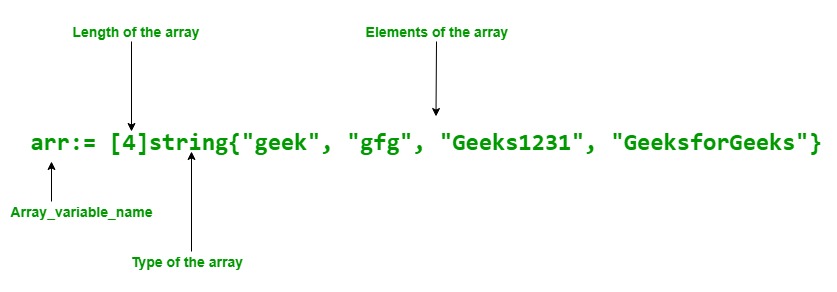
An array in Go is a fixed-size collection of elements of the same type. Once you declare its size, it cannot grow or shrink.
Declaring an Array
GO1var numbers [5]int // An array of 5 integers
This creates an array that can hold exactly 5 integers. If you try to add a 6th element, Go will produce a compile-time error.
Example: Array Usage
GO1package main 2 3import "fmt" 4 5func main() { 6 var arr = [3]string{"Go", "Rust", "Python"} 7 fmt.Println(arr) // Output: [Go Rust Python] 8 9 arr[2] = "JavaScript" // Modifying an element 10 fmt.Println(arr) // Output: [Go Rust JavaScript] 11}
Key Features of Arrays
- Fixed size, defined at compile-time
- Stored contiguously in memory
- Can hold elements of only one type
- Length is part of its type:
[5]intis a distinct type from[3]int
What is a Slice in Go?
A slice is a dynamically-sized, flexible view into an underlying array.
Unlike arrays, slices can grow and shrink, making them the standard choice in real-world applications.
Declaring a Slice
GO1var nums []int // A slice (no size specified)
Since no size is specified in the brackets, Go creates a slice rather than an array.
Example: Slice in Action
GO1package main 2 3import "fmt" 4 5func main() { 6 fruits := []string{"Apple", "Banana", "Cherry"} 7 fmt.Println(fruits) // Output: [Apple Banana Cherry] 8 9 fruits = append(fruits, "Mango") // Adding an element 10 fmt.Println(fruits) // Output: [Apple Banana Cherry Mango] 11}
Key Features of Slices
- Dynamic size (grows and shrinks via
append) - Reference an underlying array
- Have a length and capacity
- Used far more frequently than raw arrays
Arrays vs Slices: Summary Comparison
| Feature | Array | Slice |
|---|---|---|
| Size | Fixed at compile-time | Dynamic, resizable |
| Memory | Stores values directly | References an underlying array |
| Flexibility | Rigid | Highly flexible |
| Use Case | Fixed-size buffers | Dynamic data collections |
Recommendation: In most cases, use slices instead of arrays unless you have a specific requirement for fixed-size allocations.
How Slices Work Under the Hood
A slice in Go is not a separate monolithic data structure. Instead, it is a header containing a view into an underlying array.
A slice has three primary properties:
- Pointer to the underlying array
- Length (number of elements currently accessible in the slice)
- Capacity (maximum elements before a new allocation is required)
Example: Understanding Slice Mechanics
GO1package main 2 3import "fmt" 4 5func main() { 6 arr := [5]int{1, 2, 3, 4, 5} 7 slice := arr[1:4] // Slice from index 1 to 3 (excluding 4) 8 9 fmt.Println(slice) // Output: [2 3 4] 10 fmt.Println(len(slice)) // Output: 3 (elements in slice) 11 fmt.Println(cap(slice)) // Output: 4 (elements from index 1 to end of array) 12}
Performance Considerations
- Slices are memory efficient because passing them copies only the 24-byte slice header rather than the entire underlying dataset.
- Arrays may be slightly faster for small, fixed collections because they avoid slice header indirection and heap escape analysis in tight loops.
Conclusion
Understanding the difference between Go arrays and slices allows you to write cleaner, more efficient concurrent code. Use arrays when buffer bounds are static and fixed, and use slices for everything else.